Component collation
Bring the specified products, printed pieces and pack elements together for each finished unit.
Hand packing and product kitting
Bring products, inserts and packaging into a complete kit under an agreed component list. Identify each variant, count per finished pack and approved arrangement so the hand-packing sequence and checks can be defined.
The short answer
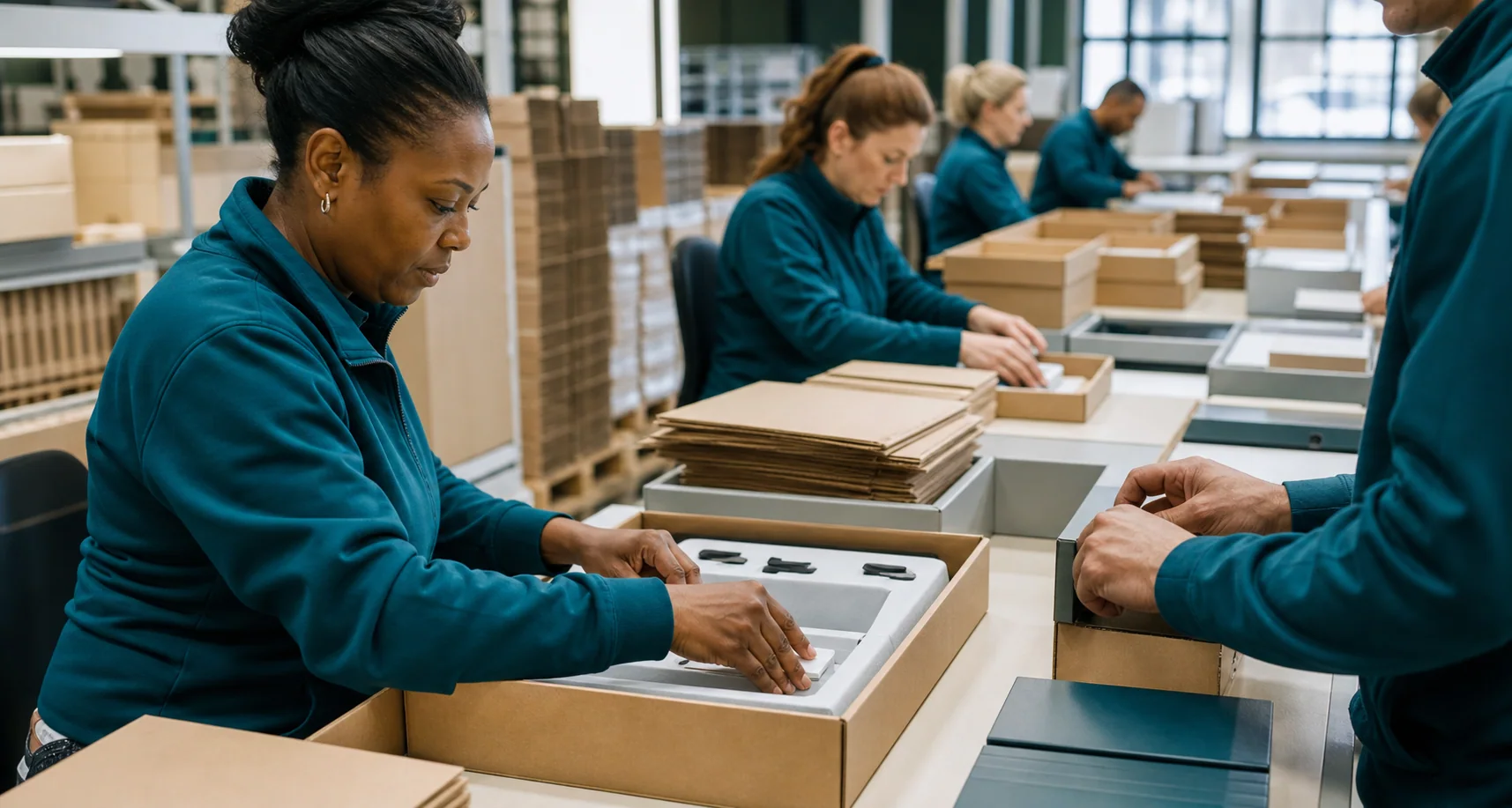
Hand packing is a manual production service for work that needs care, flexibility or multiple components. Kitting—also called collation or pack assembly—brings specified items together into one finished pack. Stockholm Ltd supports UK businesses with brief-led hand packing and kitting for launches, promotions, presentation packs and repeat requirements.
Where it fits
Manual assembly is useful when the work changes between runs, presentation matters or the pack contains components that must be brought together in a specific way.
What the work can include
A useful kitting brief describes every component, its position and the checks needed before a unit is complete. We turn that outcome into a practical sequence for production.
Bring the specified products, printed pieces and pack elements together for each finished unit.
Build multi-part packs in the agreed order, including inserts and presentation elements supplied for the project.
Complete the final arrangement, wrapping or closure defined in the approved brief.
Check that the required items are present before completed units move to the next stage.
A clear production route
Send the product, pack format, approximate quantity and target date.
Agree the components, handling, presentation and checks relevant to the work.
Turn the agreed result into a practical sequence for production.
Check, count and prepare finished work for the next step in your supply chain.
Preparing your enquiry
A component list or sample pack is the clearest starting point. Tell us what goes into one finished unit, how it should be arranged and how many units you are planning.
A product kitting service collects a defined set of components and assembles them into one ready-to-use or ready-to-distribute pack. The work can include collation, inserts, presentation and completeness checks.
It can be. Promotional and launch packs often contain varied components or presentation details that suit a flexible manual process. Share the pack specification and quantity so the requirement can be assessed.
Presentation-box enquiries are welcome. The right approach depends on the box, products, inserts, arrangement, finish, quantity and deadline, so include those details in your brief.
Yes. A first run can establish a clear component list and packing sequence for future repeat requirements, subject to the same practical review of materials, volume and timing.
Start a conversation
Share the format, quantity, timing and intended result. We will review the outline and come back to discuss whether the project is a good fit.
Record the exact component reference and quantity in one finished kit, including leaflets, dividers and small accessories. A photograph shows arrangement but may not distinguish two components with similar packaging. Pair the picture with item references and a clear variant identifier so the instruction is usable at the point of assembly.
Some items become hidden once a sleeve, insert or outer pack is closed. Place completeness checks before that point and define what can still be inspected at final release. If orientation matters, show the relevant face and datum rather than a general instruction such as “pack neatly”. Agree the acceptable presentation with an actual reference pack.
Identify the point at which the old variant stops and the next begins. Account for components still at the work area, incomplete kits and remaining labels before the new recipe is introduced. Similar-looking stock should stay identified throughout this change; a balanced final count alone cannot prove the right component went into every kit.
Define where a pack goes when its contents or presentation cannot be confirmed and who decides its next step. Keep rework instructions linked to the correct recipe revision. Use the contract-packing route for wider pack-out work and labelling and repacking when an existing item needs correction before kitting.